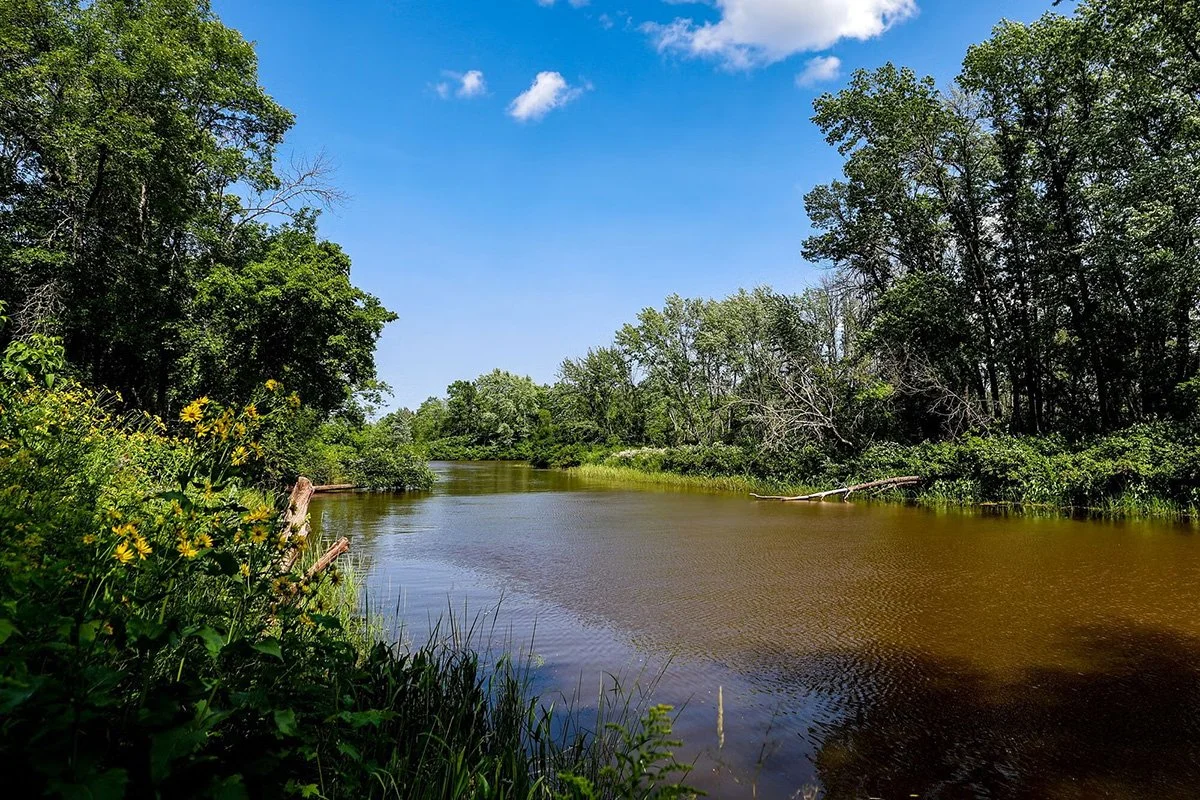
The White River, as seen on the Bad River Reservation on Aug. 12, 2025. Photo by Steven Garcia via Earthjustice.
This series follows Enbridge's ongoing construction of the Line 5 oil pipeline in Wisconsin. Right now, Enbridge is building their "re-route" section of the pipeline around Mashkiiziibii (the Bad River Reservation), posing a continual threat to Indigenous sovereignty, Lake Superior, the Bad River Watershed, and the land.
Join the Week of Resistance! From July 20–26 in Ashland, Wisconsin, water protectors near and far will come together to resist Line 5. Learn more, find your own camping, and RSVP for meals via resistline5week.noblogs.org.
A Brief History of Colonization and Resistance in This Little Corner of Turtle Island
Turtle Island is being occupied by the American Empire. Indigenous peoples all over the continent have struggled and continue to struggle against genocide, displacement, and resource extraction. Meanwhile, folks in Northern Wisconsin across the political spectrum have historically been fiercely protective of Lake Superior.
In the time before 1800 the Anishinaabeg migrated west to the Great Lakes region following a prophecy about a place where food grows on the water, in response to mounting colonial threats to their people. That food—manoomin, or wild rice—is abundant in the sloughs around Bad River, where some Anishinaabeg ended their migration. To learn more about this deeply interesting chapter of history, see here. In Wisconsin and elsewhere, Ojibwe peoples have resisted displacement since the threat of colonial violence arrived.
In 1830 the Indian Removal Act was signed into law, giving settlers and the state license for ethnic cleansing, genocide, and settler colonialism. You might remember the Trail of Tears from history class. The Indian Removal Act is the law that started that horror, and it attacked communities across Turtle Island.
In 1854, pushing back against those policies of dispossession, Chief Buffalo and other tribal chiefs went to Washington D.C. to negotiate with president Millard Fillmore for the cancellation of the Indian removal order he was administering. Fillmore agreed that in exchange for another 13 million acres of land, the Lake Superior Ojibwe could retain their homeland with extended off-reservation hunting and fishing rights. This agreement became the Treaty of 1854.
The rights guaranteed by the 1854 treaty for the Ojibwe people to be able to continue to use the land and water are referred to legally as usufructory rights. They're a cornerstone of Bad River's legal arguments, and essential to the current livelihoods and strength of the Anishinaabe communities across the region.
In 1887, the federal government's Bureau of Indian Affairs (BIA) broke up Bad River and other Native lands into small private lots called allotments—a policy extended in reach by the Dawes Act (1887), which was explicitly intended to force Native Americans to "assume a capitalist and proprietary relationship with property."
"They had been 'allotting' the land [that makes up reservations], chopping them up into pieces. The rest of the land that is not distributed is now up for sale. Those parcels were bought by lumber companies. They should never have been sold. They should have stayed in our hands. All of the extra land that is not allotted out would now be free from white settlement." —KEVIN BRUYNEEL in the film Bad River
Assimilation, a policy overseen by the BIA, was an effort to forcibly integrate native peoples into American culture. This was done to pull people away from the land, destroy traditional ecological knowledge, and support white settlement of indigenous lands. This isn't conjecture—it's the explicitly stated purpose of the policy, epitomized by the phrase "kill the Indian, save the man." To be really clear: we understand these efforts by the U.S. Government to be the elements of a genocide. We bring this history up now because that campaign of genocide has never stopped: it continues through the work of companies like Enbridge.
In 1953, the Canadian company that would become Enbridge constructed Line 5 to move oil from western to eastern Canada. Pipelines haven't always been vining across the continent: they're the oil industry's workaround to the power of striking dockworkers on the coasts. The cheapest and easiest pipeline route for the company was to dip down to the United States through the Great Lakes before heading back to Canada. Line 5 was installed on the Bad River Reservation, courtesy of the Bureau of Indian Affairs, without the consent of the Bad River Band.
The Bayfield Peninsula/Chequamegon Bay area has been settled by waves of colonizers. The people who came here historically made their livings in the logging, mining, and fishing industries. Although the vast majority of our original forests are gone and the lake is impacted by all kinds of threats, rural people generally have some level of love and respect for the land. People of many backgrounds live here now: farmers, loggers, fisherfolk, ecologists, back-to-the-landers, hippies, evangelical christians, hunters, retired academics, etc; and they have all proven able to protect the land and the waters when it counts.
Residents of many stripes are committed to the wellbeing of the Lake and the land. In facing outside threats, Native and settler communities have often fought together. The people of Bad River, in particular, have been fighting to protect their home. Joe Rose, a beloved Bad River elder who is now an ancestor, used to say that in terms of environmental campaigns and protecting the land, Bad River is batting 1000 and hasn't lost yet (in baseball terms that means they're crushing it). Bad River tribal members have been protecting their treaty rights since the treaties were signed, and their lands long before that.
The 1960-70's bring the height of the Walleye Wars (a racist conflict that flares up every spearing season to this day) as well as landmark treaty rights cases: the Gurnoe and Voigt decisions. They're hard-fought watershed affirmations of treaty rights, read more about them in Walleye Warriors by Rick Whaley and Walt Bresette.
More notable fights and wins in recent history include:
The fight against the Crandon Mine, which lasted from the 70's to 2002 down in Mole Lake. The U.S. Supreme Court affirmed their right as a sovereign nation to enforce their own clean air and water standards. This made the mine economically unviable (industry relies on sacrifice zones!) and the company sold the land to the tribe, shuttering the project for good.
A 28 day train blockade and ceremony in 1996, that stopped the transport of hazardous sulfuric acid through Bad River. We celebrate the bravery of this moment in Bad River's recent history: learn more here.
The fight against the Penokee Mine, which was proposed in 2010 and was fought for the next 5 years. Gogebic Taconite LLC (a Florida-based mining company, known locally as G-TAC) proposed an iron taconite mine in the Penokee hills of Northern Wisconsin, upstream of Bad River. Due to a mix of Tribal pressure and escalation combined with changing economics, the mining project was abandoned.
The community-wide rejection of a concentrated animal farm operation (CAFO) in 2014. Bayfield County, Red Cliff, and Bad River all rallied against the pig farm, preventing it from being built.
Lake Superior Not For Sale, a campaign to resist a south shore landowner's bid to start a water bottling company in 2020. The campaign ended in a state-level lawsuit that affirmed the local municipalities' right to say no to the project on environmental grounds.
"Often, when Native Nations assert their treaty rights and sovereignty, they are confronted with a backlash from their [settler] neighbors, who are fearful of losing control of the natural resources. Yet, when both groups are faced with an outside threat to their common environment...these communities have unexpectedly joined together to protect the resources." —Zoltan Grossman in Unlikely Alliances
The construction that is currently underway is as much a part of the same pattern of abuse against the people and the land as the rest of the history of colonization. There is a long history of missing and murdered Indigenous women in areas around man-camps. Even if Enbridge's reroute never spilled a single drop of oil (which is unlikely given theirtrack record), Enbridge is already actively threatening the very safety of Indigenous communities in this region. No matter how well-rehearsed their corporate talking points are, Enbridge is nothing more than the latest iteration of Western imperialism on Turtle Island.
Learn More:
Zine: Oil In The Lakes
Wisconsin Re-Route Maps: https://watchline5.com/wisconsin-reroute/
Watch Line 5 Monitoring: https://watchline5.com/report-form/
Self-driving tour of the Bad River Watershed: https://arcg.is/br48O
Communities United By Water: https://communitiesunitedbywater.org/
The Great Lakes Indian Fish & Wildlife Commission: https://glifwc.org/
Bad River Documentary